
Lead-213 (Pb-213) is a short-lived radioactive isotope of lead with a half-life of about 10.2 minutes. It decays by beta-minus emission to bismuth-213. Because of its very short half-life, Pb-213 rapidly disappears after production and is mainly of interest in nuclear physics and studies of radioactive decay chains.

Pb-213 has no significant commercial or medical applications and is primarily used in nuclear physics research. Studies of Pb-213 and its decay to Bi-213 provide information about the properties and decay behavior of neutron-rich nuclei in this region of the nuclear chart.

Pb-213 does not occur naturally in significant quantities because of its very short half-life. It can be produced artificially in nuclear reactions and can also appear as the daughter product of Po-217 alpha decay. In practice, Pb-213 is encountered mainly in specialized nuclear research experiments shortly after its production.
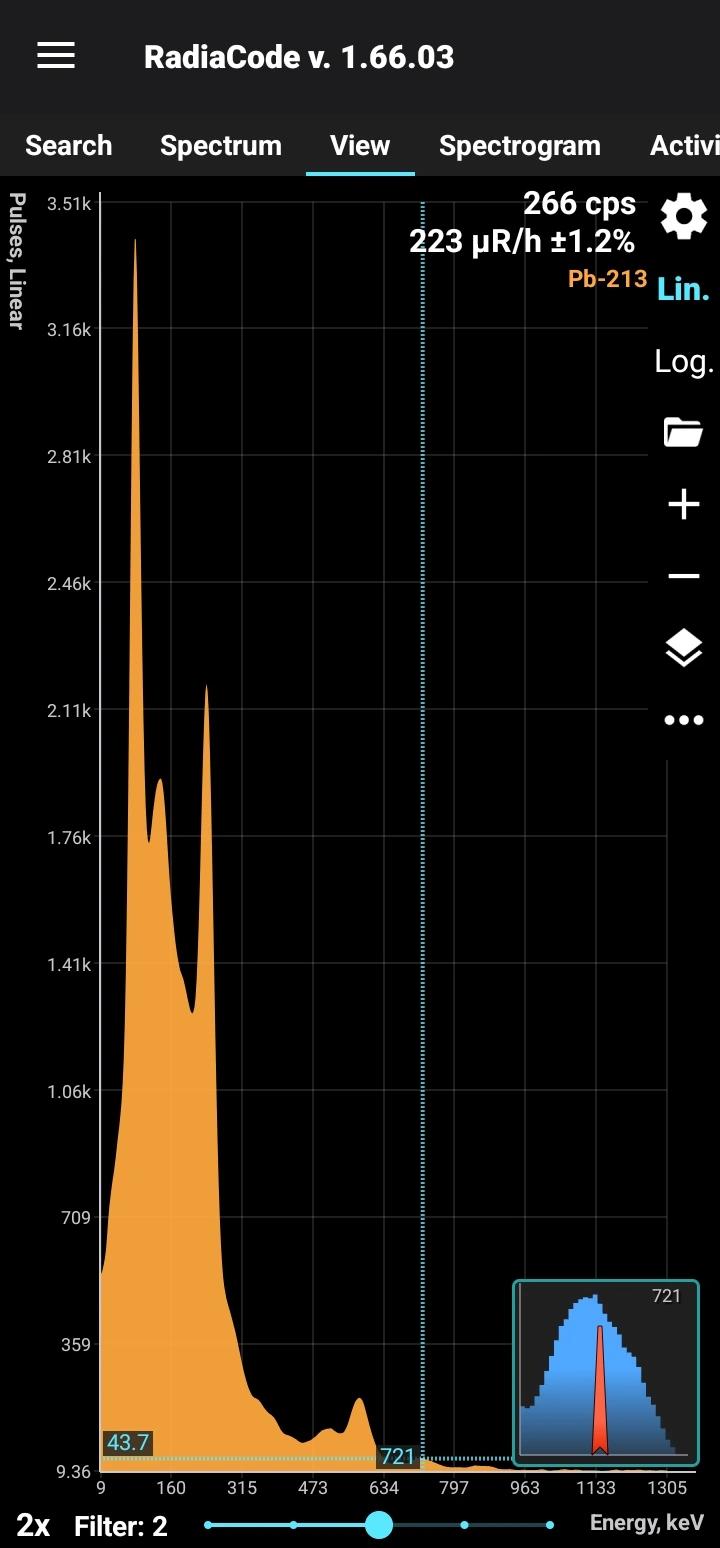
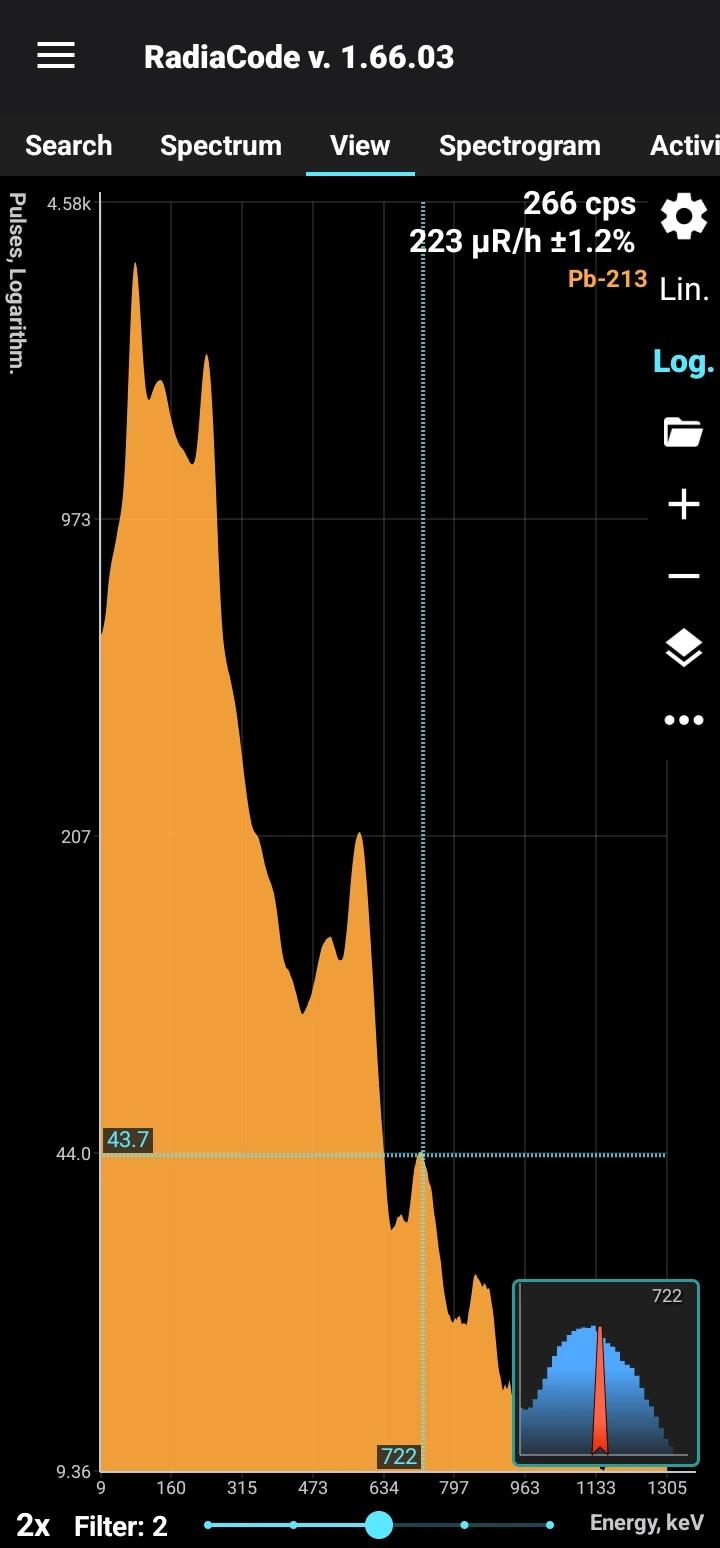
Pb-213
Plumbum-213
Half-life: 10.2 minutes Main emission lines: 257, 720, 977 keV
Decay mode Beta-
Beta-
| Intensity, % | Decay En., keV |
| 34 | (2028) |
| 23.4 | (1050) |
| 8.8 | (583) |
| 6.8 | (857) |
| 3.7 | (886) |
| 3.6 | (1154) |
| 2.6 | (533) |
| 2.3 | (733) |
| 2.3 | (1045) |
| 1.9 | (879) |
| 1.7 | (435) |
| 1.4 | (1770) |
| 1 | (826) |
| 1 | (1435) |
| 0.9 | (485) |
| 0.6 | (685) |
Gamma
| Energy, keV | Intensity, % |
| 977.5 | 17.1 |
| 257.7 | 15.4 |
| 720.3 | 9.5 |
| 1171 | 9.4 |
| 1187 | 6.3 |
| 1142.4 | 6.2 |
| 874.3 | 4.2 |
| 964.7 | 4 |
| 982.9 | 2.6 |
| 1037.7 | 2.6 |
| 302.7 | 1.89 |
| 324.2 | 1.46 |
| 1592.1 | 1.32 |
| 1237.4 | 1.26 |
| 1445.4 | 1.16 |
| 944.5 | 1.12 |
| 1149.3 | 1.06 |
| 1285.5 | 1.05 |
| 893.1 | 1.05 |
| 1029.6 | 0.74 |
| 1085.5 | 0.71 |
| 1335.5 | 0.65 |
| 274.3 | 0.62 |
| 592.9 | 0.62 |
| 913.8 | 0.49 |
| 334.9 | 0.49 |
X-rays
| Energy, keV | Intensity, % |
| 77.108 | 2.4 |
| 9.419 - 16.389 | 2.13 |
| 74.815 | 1.43 |
| 86.830 - 90.086 | 1.07 |
| 86.830 - 87.946 | 0.82 |
| 89.721 - 89.847 | 0.25 |