
Beryllium-7 (Be-7) is a naturally occurring cosmogenic radioactive isotope with a half-life of about 53.2 days. It is continuously produced in the upper atmosphere when cosmic rays interact with nitrogen and oxygen. Be-7 decays by electron capture to lithium-7 and produces a characteristic gamma-ray line at approximately 477.6 keV, making it detectable by gamma spectroscopy.

Be-7 is mainly used as a natural environmental tracer. Scientists measure it to study atmospheric circulation, aerosol transport, rainfall, and the movement of soil and sediments. Because of its relatively short half-life and strong association with surface soil particles, Be-7 is particularly useful for studying recent erosion and sediment redistribution following rainfall events.

Be-7 is continuously present in trace amounts in the atmosphere, where it attaches to airborne aerosol particles. Rain and other precipitation remove these particles from the air and deposit Be-7 onto the Earth's surface. It can therefore be detected in rainwater, air filters, surface soils, vegetation, and recently deposited sediments. Its concentration can increase after rainfall as atmospheric Be-7 is washed out and concentrated on surfaces.
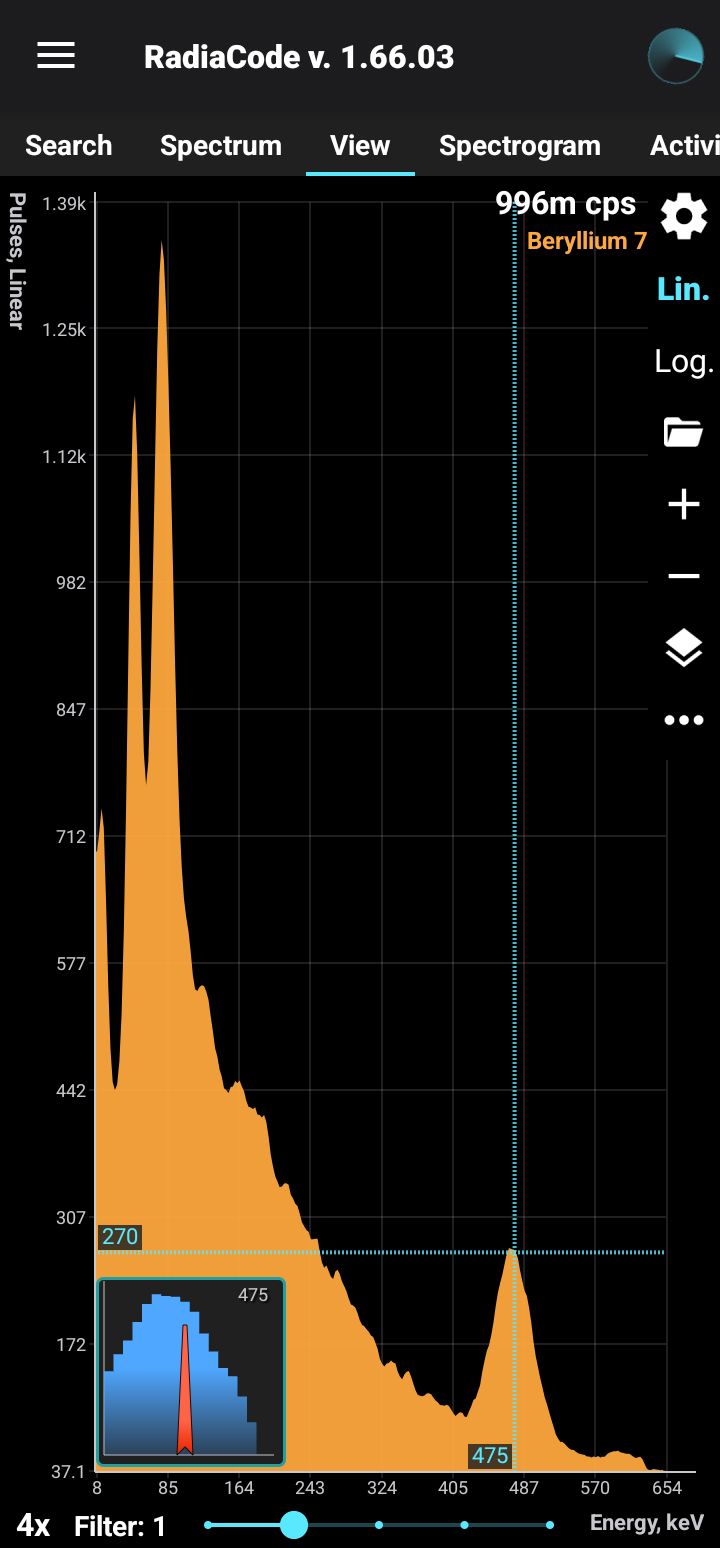
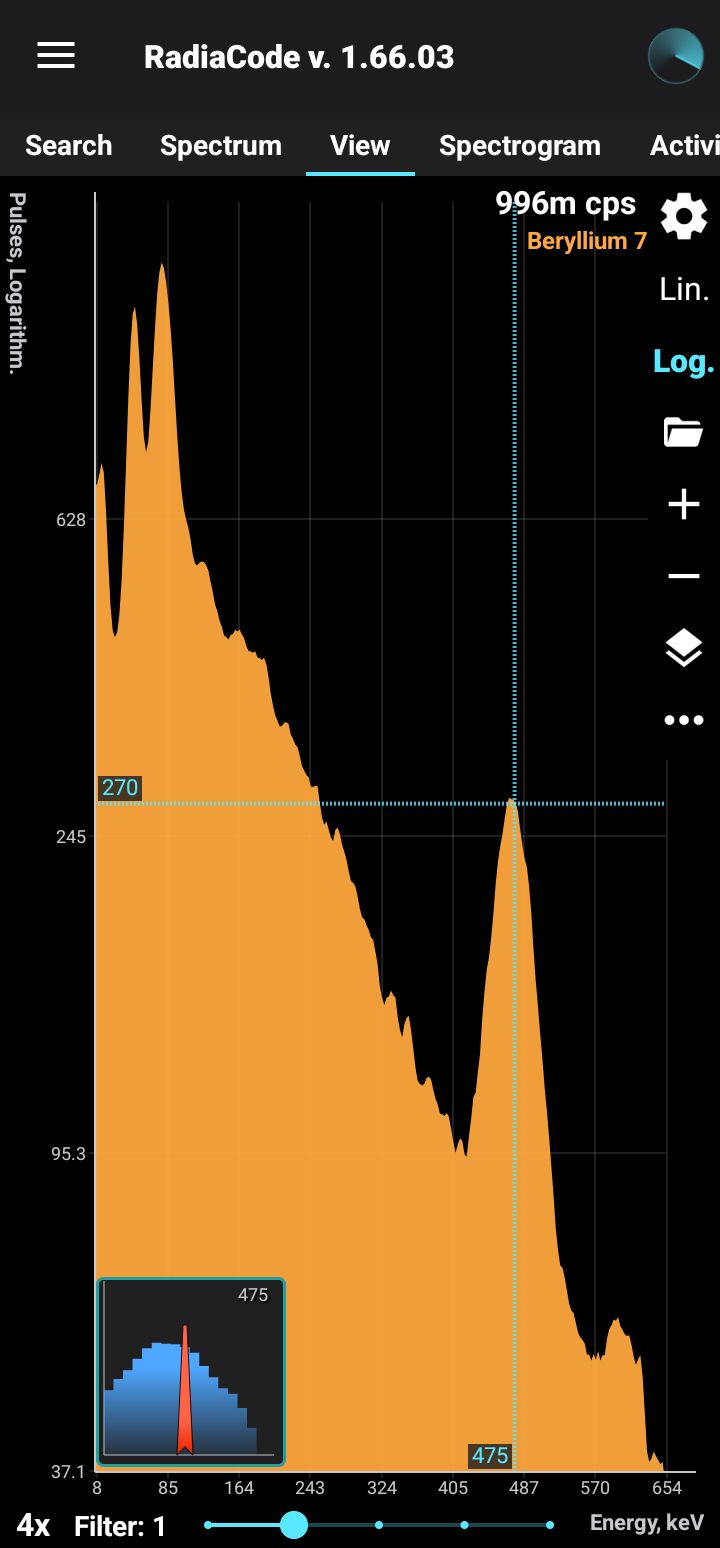
Be-7
Beryllium-7
Half-life: 53.2 days Main emission lines: 477.6 keV
Decay mode β-
Beta-
| Avg En., keV | Intensity, % | Decay En., keV |
| 5,516.51 | 54.7 | (11508.7) |
| 4,461.49 | 31.4 | (9384.1) |
| 2,155.2 | 6.5 | (4717.2) |
| 1,576.5 | 4 | (3531.2) |
| 674 | 3.1 | (1633) |
Decay mode β- α
Gamma
| Energy, keV | Intensity, % |
| 477.6 | 0.39 |